If you’re reading this, there’s a decent chance you’ve already had an appointment go badly somewhere else.
Maybe your child couldn’t tolerate the chair. Maybe the office ran forty minutes behind and the waiting room noise ended things before they started. Maybe someone suggested, in a tone you still remember, that your child needed to learn to cooperate. Parents arrive at our door having been made to feel that their kid is the difficult one, and that’s usually the first thing we want to undo.
A dental visit that doesn’t work isn’t a failure of the child. It’s an appointment that was designed for a different child.
What this actually means in our office
Special needs dentistry is less a separate procedure than a different set of decisions about how care gets delivered — how long the appointment runs, when it’s scheduled, how loud and bright the room is, how much explaining happens before anything is touched, and how much we’re willing to accomplish in one sitting versus three.
Families we work with this way include children with autism, ADHD, Down syndrome, cerebral palsy, sensory processing differences, developmental delay, genetic conditions, seizure disorders, feeding tubes and complex medical histories, and vision or hearing differences. Also plenty of children with no diagnosis at all who simply have significant dental anxiety, or who had one bad experience that stuck.
None of these categories tells us much on its own. Two autistic eight-year-olds can need almost opposite things from us — one needs the whole sequence narrated in advance, one needs us to say as little as possible. That’s why the intake conversation matters more here than anywhere else in dentistry.
Tell us everything before you come
You know things about your child that no chart contains, and we’d rather have them before the appointment than discover them during it. When you call to schedule, tell us:
- How your child communicates — verbally, with an AAC device, with signs, with behavior. Whether they understand more than they express.
- What sets things off. Overhead lights. High-pitched sounds. Being touched on the face. Latex. Mint. Waiting.
- What calms things down. The specific song, the weighted lap pad, counting to ten, deep pressure on the shoulders, being left alone for ninety seconds.
- Words to avoid. Some kids have a trigger word from a past medical experience. Tell us and we’ll never say it.
- Time of day. When is your child at their best? For a lot of families that’s first thing in the morning, before the day has accumulated.
- Medications and medical history — including seizure history, cardiac conditions, shunts, aspiration risk, and anything requiring premedication.
- What went wrong last time, in detail. This is the most useful thing you can give us.
None of this is oversharing. It’s the difference between an appointment that works and one that doesn’t.
What we change
Depending on what your child needs, we can adjust:
- The schedule. Longer appointments so nothing is rushed, and first-of-the-day or quiet-period slots when the office is calmest and there’s no waiting-room crowd.
- The wait. If a lobby is impossible, wait in the car and we’ll text you when the room is ready. Plenty of families do this.
- The room. Lights dimmed, overhead light angled away, sunglasses offered, noise-canceling headphones welcome, television off if it’s too much.
- The seating. Not every child uses the chair. Some sit in a parent’s lap. Some stay in their wheelchair. Some do better sitting up than reclined.
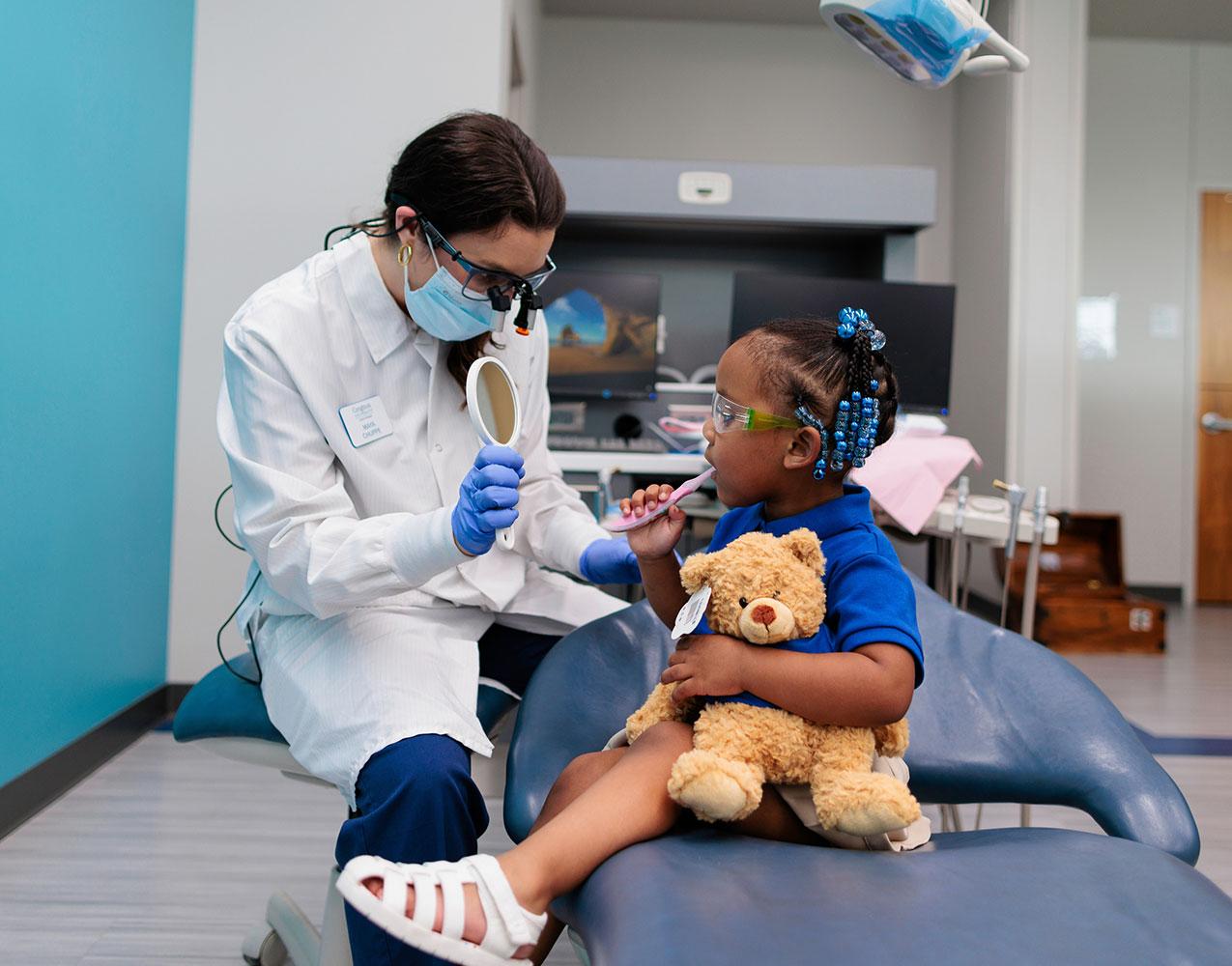
- The pace. We narrate what’s next, count out loud so there’s a known endpoint, and stop when a break is needed rather than pushing through.
- The scope. Sometimes the whole goal of visit one is sitting in the chair and having teeth counted with a mirror. That’s a completed appointment as far as we’re concerned.
Desensitization visits
For children who can’t get through an exam yet, we build up in stages across separate short visits — walking into the operatory and back out, then sitting in the chair, then a mirror in the mouth, then the polisher on a fingernail before it ever touches a tooth.
It looks slow written down. In practice it’s usually faster than repeatedly attempting a full appointment that ends in distress, because every failed visit makes the next one harder. Building tolerance means the child arrives at appointment four already knowing the room, the people, and the smell of the place.
The comfort techniques we use, in plain language
Tell-show-do. Explain it in words your child understands, show them the instrument and let them touch it or try it on a finger, then use it. Nothing enters the mouth that hasn’t been introduced.
Visual supports. Picture schedules, social stories, and photos of our office and team ahead of time so the building isn’t a surprise. If a visual schedule works at home or school, bring it.
Counting and predictability. “Ten more seconds” and then genuinely stopping at ten. Doing what we said we’d do is the entire basis of trust with a child who has been told otherwise before.
Breaks on request. A raised hand means we stop. If that only works once, it works once — but for most kids, learning they have real control changes the whole dynamic.
Positive reinforcement for what actually happened, not generic praise.
For children who need more than behavioral support to get through treatment, nitrous oxide — laughing gas — is available in our office and is often enough on its own. Our sedation options page walks through what’s offered here and what requires a hospital setting.
Why oral health risk runs higher — and what to do about it
Several factors stack up for many of our patients, and it helps to know which ones apply to your child:
- Medications. Many liquid pediatric formulations are sweetened, and a nightly dose coats the teeth at the worst possible hour. Others — some seizure medications, stimulants, and antihistamines — reduce saliva, and saliva is the mouth’s main defense. Some anticonvulsants cause gum overgrowth that traps plaque.
- Restricted diets. Children with strong texture preferences often land on soft, carbohydrate-heavy foods that linger on teeth. Tube-fed children can develop heavy calculus because the mouth isn’t clearing itself through chewing.
- Brushing resistance. If getting a brush into your child’s mouth is a daily fight, plaque wins some days. Everyone knows this and nobody says it out loud.
- Reflux. Common in several conditions, and repeated acid exposure erodes enamel directly.
- Mouth breathing and bruxism. Both change wear patterns and gum health.
Ask us about prescription-strength fluoride toothpaste and more frequent varnish applications. For kids at meaningfully higher risk, a three-month or four-month checkup and cleaning interval instead of six months is often the right call — more short visits, less crisis. Sealants on the permanent molars are also worth asking about early, since they take minutes and require no drilling or numbing.
Home care when brushing is genuinely hard
Advice that assumes a cooperative child is useless to you. What tends to help:
- Same time, same place, same order, every day. Predictability does more work than technique.
- Try standing behind your child with their head resting against you, rather than facing them. Better angle, better view, less confrontational.
- Electric brushes go either way. The vibration is intolerable for some children and organizing for others. Worth one trial.
- Change the toothpaste. Mint is spicy to a lot of kids. Unflavored and mild fruit fluoride toothpastes exist — ask us for options.
- Adaptive tools. Thick handles, three-sided brushes, floss picks instead of string. Small changes, real difference.
- Two ten-second sessions beat one abandoned two-minute battle. Consistency over duration.
- Water and fluoride rinse after sweetened medication, when a full brushing isn’t going to happen.
Bring us your actual routine, including the parts that aren’t working. We can only troubleshoot what we know about.
When in-office care isn’t the right answer
Sometimes it isn’t, and we’ll say so. If a child needs significant treatment that can’t be safely completed awake, general anesthesia in a hospital setting with a specialist and an anesthesia team may be the right answer. That conversation happens openly and with your input — weighing the treatment needed, the medical history, and what repeated distressing appointments cost a child over time. There’s no version of this where we push a child past what they can handle to avoid an awkward conversation.
The transition nobody warns you about
We care for kids through age eighteen — see our dental care for teens page for what those years look like — and for families of children with complex needs, aging out of a familiar office is a genuine loss. Start asking about the transition around fifteen or sixteen rather than at the last visit. We’d rather help you find the right adult provider with two years of runway than hand you a phone number on the way out the door.
Book a visit at Dino Kids Dental of Raleigh
Our office is on Tin Roof Way in North/Northeast Raleigh, off Louisburg Road just inside I-540 near Triangle Town Center, and it’s wheelchair accessible. Families come to us from North Raleigh, Northeast Raleigh, Wake Forest, Rolesville, Knightdale, and Wendell. If it’s been a while since your child saw a dentist because the last attempt was hard, that’s a normal reason to have waited — and a good reason to call and talk it through before you book anything. Tell us what you’re working with and we’ll build the visit around it.
Dino Kids Dental of Raleigh 5321 Tin Roof Way, Suite 101 Raleigh, NC 27616

Phone: (919) 341-2257

Email: raleigh@dksmiles.com

Hours: Monday–Thursday, 8:00 AM to 3:00 PM. Select Fridays by availability.

Request an appointment online
Related pages
- Special Healthcare Needs Dentistry
- Sedation Dentistry for Kids
- Kids’ Dental Exams & Cleanings
- Dental Sealants
- Dental Care for Teens
- Emergency Pediatric Dentistry
Frequently Asked Questions
What is special needs dentistry?
It’s dental care adapted to a child’s physical, developmental, behavioral, sensory, or medical needs. The clinical work is often the same — what changes is appointment length, scheduling, sensory environment, pacing, communication, and how much is attempted in a single visit.
Which children benefit from this approach?
Children with autism, ADHD, Down syndrome, cerebral palsy, sensory processing differences, developmental delays, seizure disorders, genetic conditions, complex medical histories, and vision or hearing differences. Also children with no diagnosis who have severe dental anxiety or a bad past experience.
What should I tell the office before our first appointment?
How your child communicates, what triggers distress, what calms them, words to avoid, their best time of day, full medical and medication history, and specifically what went wrong at previous dental visits. That last one is the most useful information you can give us.
Can we wait somewhere other than the lobby?
Yes. Many families wait in the car and we text when the room is ready — call us at (919) 341-2257 and let us know that’s what you’d like. If a waiting room is a barrier, it shouldn’t be the reason care doesn’t happen.
Are longer or quieter appointments available?
Yes. Longer appointments and quieter time slots, including first-of-the-day scheduling when the office is calmest, can be arranged based on what your child needs.
What if my child won’t sit in the dental chair?
Then we don’t use it. Some children sit in a parent’s lap, some stay in their wheelchair, and some do better upright than reclined. We also offer desensitization visits, where the goal of an early appointment may simply be entering the room and leaving successfully.
Why do children with special health care needs get more cavities?
Several factors stack up: sweetened liquid medications, medications that reduce saliva, texture-limited diets, difficulty brushing, reflux, mouth breathing, and grinding. Knowing which apply to your child lets us adjust prevention accordingly.
How often should my child come in?
Every six months is standard, but a three- or four-month interval is often better for children at higher decay risk. More frequent short visits usually mean less extensive treatment later, and they keep the office familiar.
Is sedation an option?
It may be. Nitrous oxide (laughing gas) is available in our office and is often enough on its own. For treatment that can’t be safely completed awake, general anesthesia in a hospital setting with a specialist and an anesthesia team may be appropriate. That’s a decision we make together after reviewing the full picture — never a default.
What happens when my child turns eighteen?
We see patients through age eighteen. Start the conversation about transitioning to an adult provider around age fifteen or sixteen so there’s time to find a good fit rather than scrambling at the last visit.
