
A baby tooth is pulled, or knocked out on a scooter, or lost to decay that got too far. The immediate crisis passes. And then somebody tells you your six-year-old needs an appliance cemented into their mouth for the next four years, which sounds like an enormous response to losing a tooth that was going to fall out anyway.
Here’s the reasoning, and it comes down to one fact about how mouths behave: teeth move toward empty space. Not slowly, and not eventually. A back molar can start tipping into a gap within weeks, and in some children a meaningful amount of space is gone in a few months.
That’s the whole problem a space maintainer exists to solve.
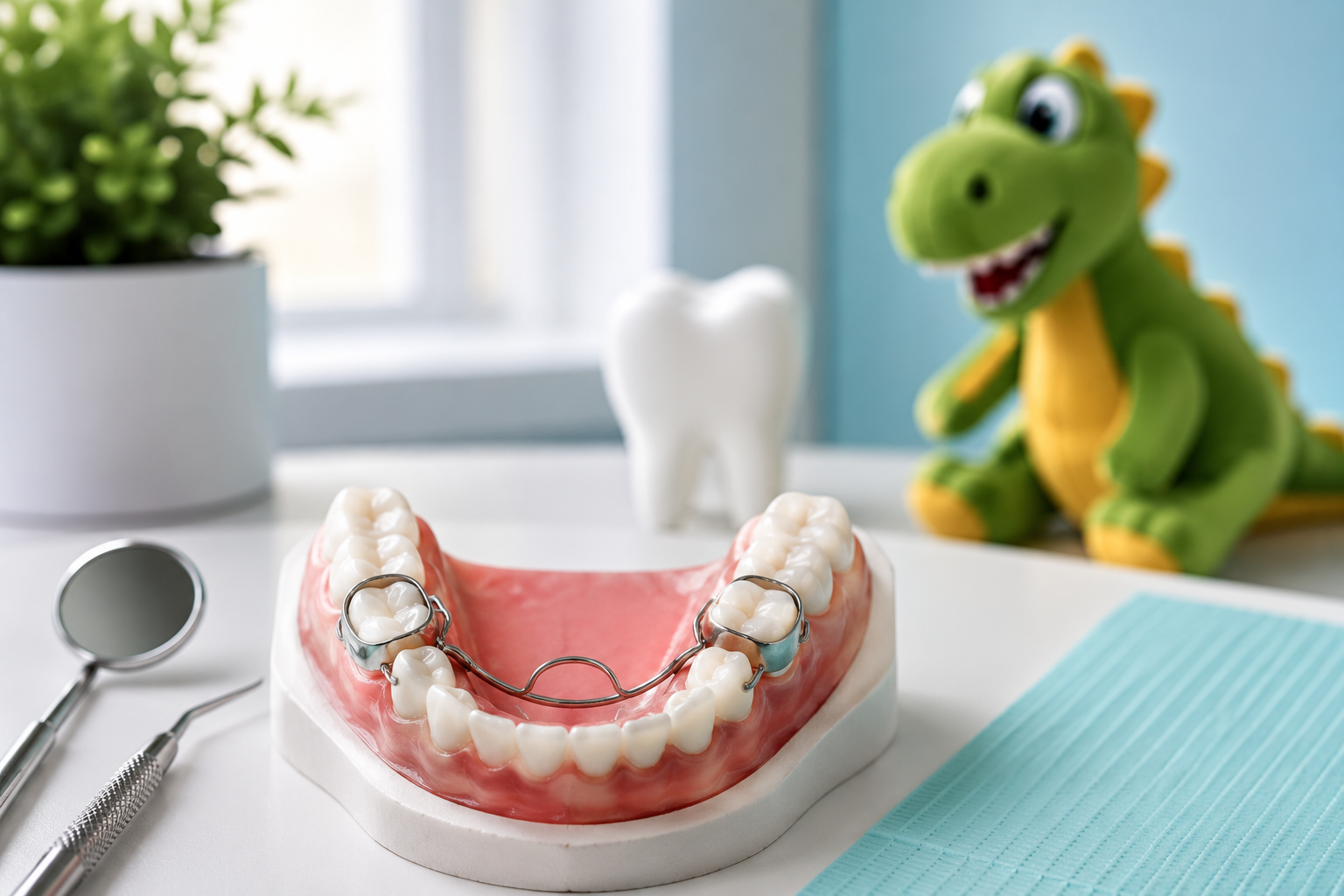
Why the gap matters more than it looks like it should
Every baby tooth is standing on top of the permanent tooth that will replace it, holding that exact width of jaw open until the adult tooth is ready. Lose the baby tooth on schedule and the permanent one is already pushing up underneath, so the gap closes with the right tooth. Lose it three years early and there’s nothing underneath ready to come in — just an opening the neighboring teeth are happy to lean into.
When the permanent tooth finally arrives, its parking space is partly occupied. It comes in rotated, or crowded, or gets stuck under the bone entirely and never erupts on its own. That last outcome is the expensive one, because it can mean surgical exposure and orthodontic traction to pull the tooth down.
None of this is about appearance. It’s about whether an adult tooth has somewhere to go.
The tooth that matters most
Not every early loss carries the same weight, and this is worth knowing because it’s the part parents are never told.
The second baby molar is the big one. It sits directly in front of where the six-year molar erupts, and it’s the tooth doing the most work to hold the back of the arch open. Losing it before the six-year molar has come in is the highest-risk scenario in the whole discussion, because that first permanent molar will drift forward into the space it should have been growing behind. This is the single most common reason we place an appliance.
The first baby molar matters, but less. Drift still happens, and we still often maintain the space.
Front baby teeth usually don’t need one. A toddler who knocks out an upper front tooth on the driveway typically loses very little space, because the front of the arch doesn’t collapse the way the back does. The concerns there are speech and appearance, not crowding, and those are handled differently.
When we’ll tell you not to bother
We don’t place a space maintainer every time a baby tooth comes out early, and we’ll say so plainly when one isn’t warranted.
The main factor is how close the permanent tooth is to arriving. If an X-ray shows it already erupting through the bone and likely to break through within roughly six months, an appliance would be cemented in, cause a maintenance burden, and then come right back out. Not worth it. Age matters too — the same tooth lost at five is a different problem than at ten.
Sometimes the honest answer is that we take an X-ray, wait, and reassess in a few months. Appliances aren’t free of downside, and a child who doesn’t need one shouldn’t have one.
The actual appliances
Band and loop. The workhorse. A metal band cemented around the tooth behind the gap, with a wire loop extending forward to rest against the tooth in front. It holds one space, in one quadrant. Most children who need maintenance get this.
Distal shoe. Used when the second baby molar is lost before the six-year molar has erupted, so there’s no back tooth to lean the loop against. A small extension sits just under the gumline to guide the incoming molar into the right position. It sounds more involved than it feels — but it does need close monitoring, so we’ll want to see your child on a tighter schedule.
Lingual holding arch. A wire running along the inside of the lower teeth, anchored on both sides. Used when there are gaps on both sides of the lower arch.
Nance or transpalatal arch. The upper equivalent, with a wire crossing the roof of the mouth.
Which one your child gets is decided by which tooth was lost, whether it’s upper or lower, and how many spaces need holding. It’s not a preference question.
Getting one placed
The appointment is straightforward and there’s no drilling involved. We look at the area, take an X-ray to see where the permanent tooth is sitting, then take an impression or digital scan — the scan is the easier experience for most kids, since there’s no tray and no goop. The appliance comes back from the lab, we try it in, adjust the fit, and cement it. Most children need no numbing and no sedation for any of it.
Expect a few days of your child noticing it constantly. Tongues find new objects and won’t leave them alone. That settles.
Living with it
Almost every space maintainer failure comes from the same short list, so this section matters more than the placement does:
- Sticky candy is the enemy. Taffy, caramel, gummy bears, fruit snacks. They grab the wire and pull the band loose. This is the number one cause of appliances coming out early.
- No ice, no hard candy, no chewing on pen caps. Same principle, different failure mode.
- Brush around the band deliberately. The margin where the band meets the tooth traps plaque, and a cavity developing underneath a cemented band is a genuine risk. This is a spot to point the brush at on purpose, not just sweep past.
- Don’t let them push on it with a finger or tongue. Kids do this idly. Repeated pressure loosens cement.
- Call us the day it feels loose. Don’t wait for the next scheduled visit. A loose band can be re-cemented easily; one that comes off and gets lost means starting over, and meanwhile the space is closing.
If it does come out at home, keep it and bring it in. Often it can go straight back on.
How long it stays
Until the permanent tooth is ready to come through, which depends entirely on which tooth we’re holding space for. Sometimes that’s a year. With a second baby molar lost at five, it can be five or six years.
We check it at every checkup — fit, cement, gum health around the band, and how close the permanent tooth is getting on X-ray. Removal is quick and painless when the time comes.
Does this mean no braces?
No, and be skeptical of anyone who suggests otherwise. Crowding has multiple causes, and jaw size relative to tooth size is largely inherited. Your child may well need orthodontic treatment regardless.
What a space maintainer does is keep an avoidable problem from being added on top of whatever your child was already going to have. It’s cheaper and simpler than recovering lost space later, which typically requires active orthodontic appliances to push teeth back where they belong.
Preventing the loss in the first place
Two causes account for most early baby tooth loss, and both are largely preventable.
Decay that got too deep. A cavity caught at a six-month checkup is usually a small filling. The same cavity found eighteen months later can be a crown, a nerve treatment, or an extraction — and then this conversation. Sealants on the molars close off the grooves where most of it starts.
Trauma. Youth sports are constant in this part of Wake County, and a fitted mouthguard is the cheapest protective equipment your child will ever wear. Every rec league season we see teeth that a fifteen-dollar guard would have saved. Scooters, trampolines, and bike ramps account for most of the rest.
If your child does take a hit to the mouth, get seen quickly — a tooth that’s been displaced or loosened has a much better outlook when it’s treated the same day. Ask us about emergency care.
Book a visit at Dino Kids Dental of Raleigh
If your child has lost a baby tooth early — recently or a while back — it’s worth having us look at what the space is doing. An X-ray answers the question quickly, and the answer is often that nothing needs to be done. Our office is on Tin Roof Way in North/Northeast Raleigh, off Louisburg Road just inside I-540 near Triangle Town Center, and we see families from North Raleigh, Northeast Raleigh, Wake Forest, Rolesville, Knightdale, and Wendell.
Dino Kids Dental of Raleigh
5321 Tin Roof Way, Suite 101
Raleigh, NC 27616

Phone: (919) 341-2257
Email: raleigh@dksmiles.com

Hours: Monday–Thursday, 8:00 AM to 3:00 PM. Select Fridays by availability.

Request an appointment online
Related pages
- Space Maintainers
- Baby Tooth Extractions
- Dental Crowns for Kids
- Dental Sealants
- Emergency Pediatric Dentistry
Frequently Asked Questions
What is a space maintainer?
It’s a small custom appliance cemented onto the teeth beside a gap left by a baby tooth lost too early. It stops the neighboring teeth from drifting into that gap so the permanent tooth underneath has room to erupt.
Which lost baby teeth actually need one?
The second baby molar is the highest priority, especially when it’s lost before the six-year molar has erupted. First baby molars often warrant one too. Front baby teeth usually don’t, since the front of the arch doesn’t collapse the way the back does.
When is a space maintainer not necessary?
When an X-ray shows the permanent tooth is close to breaking through, generally within about six months, an appliance would come right back out. Age and which tooth was lost both factor in. Sometimes the right answer is to take an X-ray, wait, and reassess.
How fast do teeth actually drift?
Faster than most parents expect. Movement can begin within weeks of the loss, and a meaningful amount of space can close within a few months, which is why we want to evaluate the gap sooner rather than later.
What types are there?
Band and loop for a single space, distal shoe when there’s no erupted molar behind the gap to anchor against, and a lingual holding arch or Nance appliance when spaces on both sides of an arch need holding. Which one is determined by the situation, not preference.
Does placing one hurt?
No. There’s no drilling, and most children need neither numbing nor sedation. We take an X-ray and a scan or impression, the lab makes the appliance, and we fit and cement it at a second short visit.
What foods should my child avoid?
Sticky candy is the main threat — taffy, caramel, gummy bears, and fruit snacks pull the band loose and cause most early failures. Also avoid chewing ice, hard candy, and pen caps.
What do I do if it feels loose or falls out?
Call us that day rather than waiting for the next visit. A loose band can usually be re-cemented. If it comes off, keep it and bring it in, since it can often go straight back on. Meanwhile the space is closing.
How long will it stay in?
Until the permanent tooth is ready to come through, which can be one year or five or six depending on which tooth we’re holding space for. We check fit and progress at every checkup and remove it when it’s no longer needed.
Will a space maintainer mean my child avoids braces?
No. Crowding has several causes and jaw size is largely inherited, so orthodontic treatment may still be needed. What the appliance prevents is an avoidable problem stacking on top of that — and regaining lost space later is harder and more expensive than holding it now.
