Almost every parent who asks us about sedation is really asking two questions at once. The stated one is how it works. The real one is whether it’s safe to let someone give their child a medication that changes how awake they are.
That’s a reasonable thing to want a direct answer about, so this page is written to give you one — including the parts that are less reassuring, like when we think a child shouldn’t have it and when we’ll send you somewhere else entirely.
Start here: most kids don’t need it
The great majority of children get through fillings, crowns, and extractions with nothing but good technique and enough time.
What does the work is not medication. It’s showing every instrument before it’s used, so nothing arrives as a surprise. Counting out loud and actually stopping at the number we said. Letting a child raise a hand to pause. Numbing thoroughly and waiting long enough for it to take hold before starting. Scheduling a nervous child first thing in the morning rather than after a long wait in a busy lobby.
When those things are done properly, most kids are fine. Sedation enters the conversation when they aren’t — not as a first move.
When we do bring it up
Usually one of these is true:
- Fear is severe enough that treatment genuinely cannot be completed, and pushing through would cost your child more than the cavity does.
- Your child is very young — two or three — with real treatment needed, and simply doesn’t have the developmental capacity to hold still for it yet.
- There’s a lot to do. Several quadrants of work turns into many appointments, and each one erodes a little more goodwill.
- A gag reflex makes back-teeth work genuinely difficult.
- A medical or developmental condition means the usual approach isn’t going to get there. Our special healthcare needs page covers the accommodations we try before this point.
- Trauma needs immediate attention and there’s no time to build up slowly.
Note what isn’t on that list: parent convenience, or a single hard appointment. One rough visit is usually a signal to change the approach, not to medicate.
What’s available at our office
Two things, and it’s worth being precise because parents researching this topic run into a lot of options that may not be on the table where they actually go.
Nitrous oxide (laughing gas)
This is what we use in our office, and for most children who need something, it’s enough.
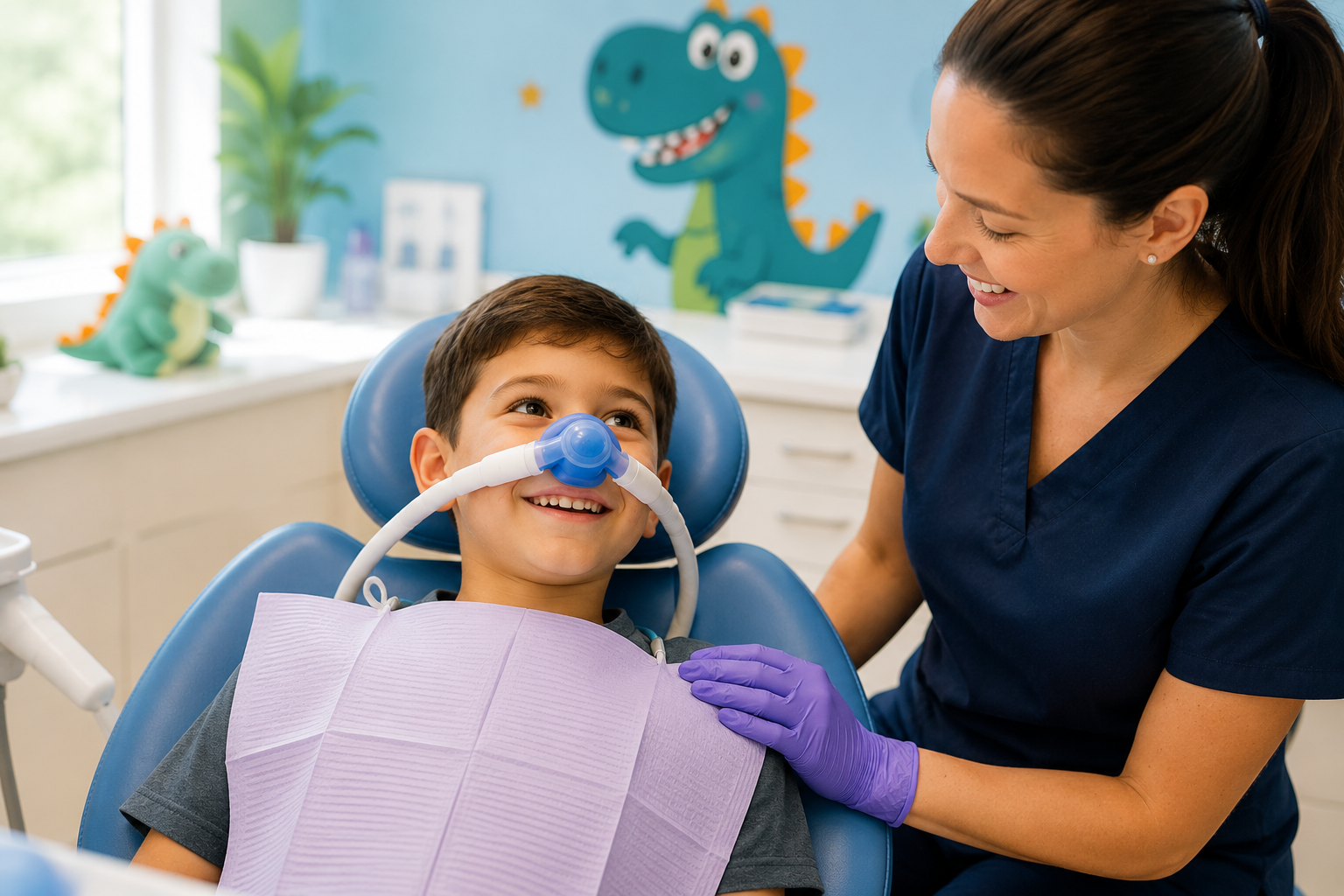
A small soft nosepiece sits over the nose — we call it a nose tickler, and it comes in flavors kids pick themselves. Your child breathes normally through their nose and within a few minutes feels floaty, warm, and noticeably less bothered by what’s happening. They stay fully awake. They talk to us. They remember the visit. They can respond to everything we ask.
The characteristic that makes it so useful in children’s dentistry is how quickly it reverses. We control the concentration continuously and can dial it up or down mid-procedure. At the end your child breathes pure oxygen for a few minutes and the effect is essentially gone. Most kids go back to school the same day.
Two practical limits nobody mentions. First, it only works if your child can breathe through their nose — a stuffy nose from a cold or bad allergy week means it won’t do much, which is a real consideration during spring pollen season here. Second, it requires keeping the nosepiece on, and a child who pulls it off repeatedly can’t benefit from it. Neither is a failure; it just means we need a different plan.
A light meal beforehand is better than an empty stomach, which cuts down on the queasiness a small number of kids feel.
General anesthesia, through a specialist
When treatment genuinely cannot be completed awake, the answer is general anesthesia in a hospital or surgery center — performed by a specialist with a dedicated anesthesia team and full monitoring, not in a general dental office.
Everything gets done in one appointment while your child is fully asleep, with an anesthesiologist whose only job is watching your child. Medical clearance is required first. Fasting instructions are strict and not negotiable. You’ll need a second adult so one of you can sit with your child on the drive home.
We’ll tell you honestly when we think this is the right path and help you get to the right provider. What we won’t do is attempt something in our chair that belongs in an operating room.
A note on oral sedation
You’ll see this in your research: a liquid medication given before the appointment to make a child drowsy. It’s used in some children’s dental practices. It is not one of the options we provide here, and we’d rather say that plainly than have you arrive expecting it.
The math nobody lays out for you
Parents often frame this as sedation versus no sedation, as though declining is automatically the gentler choice. Sometimes the actual comparison is different.
A four-year-old with decay in six teeth is looking at three or four awake appointments, each involving numbing, each with a decent chance of ending in distress, spread across two months. Or one appointment where they wake up finished. The second option carries the risks that come with anesthesia, which are real and worth taking seriously. The first carries a different cost — a child who learns that the dental office is a place where bad things happen, and who then fights every visit for the next decade.
Neither is free. We’ll lay out both honestly and the decision is yours.
Before the appointment
Whatever the plan, tell us everything: every medication and supplement including over-the-counter, allergies, asthma, snoring or sleep apnea, any reaction a family member has had to anesthesia, recent illness, and how any previous sedation went. Small details change what we recommend.
If your child has a cold, a fever, or a bad cough, call us. Congested airways change the picture and rescheduling is usually the right call.
Dress them in comfortable clothes with sleeves that push up easily. Bring the comfort object.
What to say to your child — and what not to
This matters more than parents realize, and the instinct is usually wrong.
Skip the reassurance that it won’t hurt. You’ve just introduced the possibility of hurt into a child’s head where it wasn’t. Skip the bribe negotiated in the parking lot, which signals that something bad is coming. Skip any relative’s story about their own dental experiences, and if a sibling has strong opinions, keep them out of it.
Instead: we’re going to the tooth doctor, they’re going to help your tooth feel better, they have a nose tickler that makes you feel floaty. Matter-of-fact and brief. Let us handle the explaining — we do it in a specific order for a reason, and we do it several times a day.
Afterward
After nitrous, most children are essentially back to normal within minutes and can eat and return to school. The main aftercare concern isn’t the gas at all — it’s the numb lip. Anesthetic keeps the lip and cheek numb for one to three hours, and young children will chew on that numb tissue without registering it, sometimes hard enough to create an alarming sore hours later. No eating until the numbness is fully gone, and keep an eye on them.
After general anesthesia, expect grogginess for the rest of the day, some wobbliness on their feet, and possible nausea. Quiet activity, clear liquids first, soft foods after. Your child’s recovery instructions come from the team that provided the anesthesia and should be followed exactly.
Getting out of the sedation cycle
The reason we push so hard on six-month checkups, sealants, and fluoride is that they keep this conversation from happening. Nearly every child who needs sedation for extensive work got there through decay that went unfound for a while.
Catch it at a checkup and it’s a small filling in a cooperative child. Catch it two years later and we’re discussing operating rooms.
Book a visit at Dino Kids Dental of Raleigh
If your child is anxious about dental care, or a previous office told you sedation was the only option, come talk it through before you commit to anything. Often there’s a middle path that hasn’t been tried. Our office is on Tin Roof Way in North/Northeast Raleigh, off Louisburg Road just inside I-540 near Triangle Town Center, serving families in North Raleigh, Northeast Raleigh, Wake Forest, Rolesville, Knightdale, and Wendell.
Dino Kids Dental of Raleigh
5321 Tin Roof Way, Suite 101
Raleigh, NC 27616
Phone: (919) 341-2257
Email: raleigh@dksmiles.com
Hours: Monday–Thursday, 8:00 AM to 3:00 PM. Select Fridays by availability.
Related pages
- Sedation Dentistry for Kids
- Special Healthcare Needs Dentistry
- Tooth-Colored Fillings
- Dental Crowns for Kids
- Kids’ Dental Exams & Cleanings
- Emergency Pediatric Dentistry
Frequently Asked Questions
Does my child actually need sedation?
Probably not. Most children complete treatment with good technique, enough time, and thorough numbing. Sedation is for situations where fear is severe enough to prevent care, a child is too young to hold still for necessary work, there’s extensive treatment to complete, or a medical condition makes the usual approach unworkable.
What sedation is available at your office?
Nitrous oxide, also called laughing gas, alongside behavior guidance techniques. When treatment can’t be completed awake, we refer for general anesthesia with a specialist in a hospital or surgery center rather than attempting it in our chair.
Will my child be asleep with laughing gas?
No. Your child stays fully awake, talks to us, and remembers the appointment. Nitrous reduces anxiety and makes the experience feel less bothersome — it isn’t being put to sleep.
How quickly does nitrous wear off?
Within minutes. Your child breathes pure oxygen for a few minutes at the end and the effect is essentially gone. Most children go back to school the same day.
When does laughing gas not work?
When your child can’t breathe through their nose — a cold or a heavy pollen week will blunt it — or when a child won’t keep the nosepiece on. Neither is a failure. It just means a different plan is needed.
Should my child eat before nitrous?
A light meal is better than an empty stomach and reduces the queasiness a small number of children experience. Fasting rules are different for general anesthesia, where instructions are strict and must be followed exactly.
Is general anesthesia done in your office?
No. It’s performed by a specialist in a hospital or surgery center with a dedicated anesthesia team and full monitoring. Medical clearance is required beforehand, and you’ll need a second adult so someone can sit with your child on the drive home.
What should I tell you before a sedation appointment?
Every medication and supplement including over-the-counter ones, allergies, asthma, snoring or sleep apnea, any family reaction to anesthesia, recent illness, and how any previous sedation went. If your child has a cold, fever, or bad cough, call us — rescheduling is usually right.
What’s the best thing to say to my child beforehand?
Keep it brief and matter-of-fact. Avoid promising it won’t hurt, since that introduces an idea they didn’t have, and skip parking-lot bribes and relatives’ dental stories. Let us do the explaining — we do it in a particular order, several times a day.
What’s recovery like?
After nitrous, essentially immediate. The real aftercare issue is the numb lip from local anesthetic, which lasts one to three hours — no eating until sensation returns, because children chew numb tissue without realizing it. After general anesthesia, expect grogginess, unsteadiness, and possible nausea for the rest of the day.
