Pediatric Dentist Near Rolesville NC
Rolesville families have a pediatric-only dental practice 15 to 20 minutes away via I-540 — no need to compromise on specialized children’s dental care because of geography.
Dino Kids Dental of Raleigh is located at 5321 Tin Roof Way, Suite 101, and sees only children — from the first tooth through adolescence. Every element of the practice is built specifically around young patients: the clinical team, the instruments, the communication approach, the office environment, and the behavior management techniques used at every appointment.
That specialization is the meaningful distinction. A pediatric dentist isn’t a general dentist who also sees children — it’s a clinician who completed two to three additional years of residency training after dental school focused exclusively on child development, pediatric oral pathology, anxiety reduction, and the behavioral and clinical management of growing dentitions. For Rolesville families who want that level of expertise for their children, the 15 to 20 minute drive on I-540 is the straightforward answer.
NOW ACCEPTING NEW PATIENTS IN RALEIGH
Rolesville Is Growing — And So Are Its Dental Needs
Rolesville has been one of the fastest-growing communities in Wake County for over a decade, driven by families drawn to its small-town character, newer housing developments, and proximity to Research Triangle employment corridors via I-540 and US-401. That growth in young families creates a corresponding demand for pediatric healthcare services — including specialized dental care — that isn’t always available within Rolesville’s immediate borders.
Dino Kids Dental fills that gap. Families from Rolesville, Wake Forest, Youngsville, and the broader northern Wake County corridor share the same I-540 access to our Tin Roof Way location. For this entire northern Wake County community cluster, our office is the closest dedicated pediatric dental practice available.
Rolesville’s strong sense of community — Main Street Park, local schools, the tight-knit neighborhoods that define the town’s character — is mirrored in how we approach care. The same families come back every six months for years. Children who started as nervous toddlers become teenagers who check in independently. That continuity of care, across the full arc of childhood dental development, is what a dedicated pediatric dental home provides.
Why Pediatric Specialization Actually Means for Your Child
The distinction between a pediatric dental specialist and a general dentist seeing children is worth understanding concretely, because it explains why families make the trip from Rolesville rather than seeing whoever is closest.
Extended training:
Board-certified pediatric dentists complete a two- to three-year accredited residency after dental school. That residency is entirely focused on children — child development across all stages from infancy through adolescence, pediatric oral pathology, the management of dental conditions unique to primary and mixed dentitions, behavior guidance techniques, sedation, and the treatment of children with special healthcare needs. This training doesn’t overlap with general dentistry training — it extends beyond it into a completely different clinical domain.


Behavior guidance as a clinical skill:
Managing a frightened four-year-old, an anxious seven-year-old, and a resistant twelve-year-old each require completely different techniques. Pediatric dentists are trained specifically in these approaches — Tell-Show-Do technique, positive reinforcement, distraction, voice control, and when appropriate, pharmacological sedation. General dentists receive minimal formal training in these methods.
Developmental surveillance:
Every visit to a pediatric dental specialist includes evaluation of eruption timing and sequence, jaw development, bite alignment, oral habits, and growth patterns — not just assessment of existing teeth for decay. Problems caught at age 6 (a crowding pattern that will worsen, an eruption sequence abnormality, a developing crossbite) are far easier to address than the same problems caught at age 10.

Child-scaled instruments and technique:
Procedures performed with instruments scaled to children’s mouths are measurably less uncomfortable than the same procedures performed with adult instruments. Child-sized X-ray sensors, smaller mirrors, shorter needles — these aren’t details, they’re the difference between a manageable experience and an overwhelming one.
Services at Dino Kids Dental Raleigh
Preventive Care: The Foundation of Every Visit
Every six-month appointment includes professional cleaning, comprehensive examination, and the preventive treatments that protect teeth between visits.
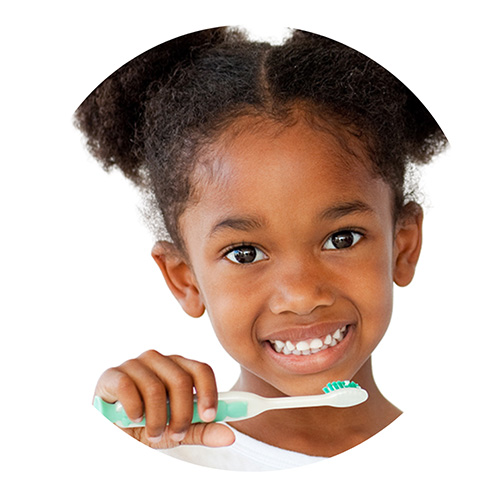
Professional cleanings remove calculus — hardened mineralized plaque — from areas that home brushing cannot reach, particularly along and below the gum margin and in interproximal spaces between teeth. Even children with excellent home hygiene accumulate calculus in these areas over time. Professional removal every six months prevents the gum inflammation that calculus drives.

Fluoride treatments applied professionally deliver fluoride concentrations significantly higher than those in toothpaste, providing targeted remineralization support for enamel under the most cavity-prone conditions. The American Academy of Pediatric Dentistry recommends professional fluoride application at least twice yearly for most children — more frequently for those at elevated cavity risk.
Dental sealants are thin resin coatings applied to the chewing surfaces of the permanent molars — the deep grooves and pits where roughly 90 percent of childhood cavities in posterior teeth develop. Bacteria and food debris that accumulate in these grooves cannot be removed by brushing alone. Sealants physically block access to the enamel in these high-risk sites. Applied to the permanent first molars shortly after they erupt at around age 6, and to the permanent second molars around age 12, sealants reduce pit-and-fissure cavity risk by up to 80 percent in the sealed teeth. No drilling, no anesthesia — minutes per tooth.
Fillings and Restorative Care
Early cavity treatment prevents a small enamel lesion from progressing to dentin involvement, and ultimately to pulp involvement requiring more extensive treatment. The clinical and financial case for treating cavities when they’re small is straightforward: smaller procedures, less discomfort, less time in the chair, lower cost.
Dino Kids Dental uses tooth-colored composite resin restorations placed with technique adapted specifically for children — topical anesthetic before any injection, explicit step-by-step preparation using Tell-Show-Do, and positive reinforcement throughout.
Sedation Dentistry: Nitrous Oxide and Beyond
For children whose anxiety cannot be fully managed through behavioral techniques alone — or for children with special healthcare needs, a strong gag reflex, or procedures requiring sustained cooperation — sedation options including nitrous oxide are available.
Nitrous oxide is inhaled through a small mask placed over the nose. It produces a mild relaxation effect while the child remains fully conscious, responsive, and able to follow instructions. The anxiolytic effect reduces reactivity to stimuli and lowers the perceived intensity of the dental environment. Effects resolve completely within minutes of removing the mask — children return to school or normal activity the same day with no residual grogginess.
For many anxious children, knowing sedation is available if needed reduces appointment anxiety before it begins — they arrive feeling more in control of their experience, which itself improves behavioral outcomes.
First Dental Visit by Age 1
The American Academy of Pediatric Dentistry recommends a child’s first dental visit by their first birthday or within six months of the first tooth appearing.
The reasoning is both preventive and developmental. Early childhood caries — tooth decay in children under 6 — is one of the most prevalent chronic childhood diseases, initiating in teeth shortly after eruption. The first visit establishes the dental relationship before anxiety has a chance to form, evaluates eruption and development against expected milestones, and gives parents evidence-based guidance on fluoride use, diet, oral hygiene technique, and oral habits (thumb sucking, pacifier use, bottle habits) at the precise developmental window when that guidance is most actionable.
Children who begin dental visits by age 1 show consistently lower anxiety at subsequent visits than children who begin later — because the dental environment becomes familiar before it’s ever associated with anything more than a gentle examination and positive interaction.
Oral Habits: Thumb Sucking and Pacifier Guidance
Thumb sucking and pacifier use are developmentally normal in infants and toddlers. Most children self-discontinue between ages 2 and 4. When the habit persists beyond age 4 — particularly into the years when permanent teeth begin erupting — it can influence jaw development and tooth alignment in ways that may require orthodontic correction.
Dino Kids Dental monitors oral habit status at every visit and provides parents with specific, developmentally appropriate guidance on when intervention is warranted and what approaches are most effective. Early, gentle intervention when habits persist is significantly more effective than late-stage correction after dental and skeletal changes have already occurred.
Care Across Every Stage of Childhood
Infants and Toddlers (0–3): First tooth evaluation, eruption monitoring, parent guidance on fluoride and feeding habits, establishing the dental relationship before anxiety develops.
Preschool and Early Elementary (3–7): Prevention focus — cleanings, fluoride, sealant timing for first molars, cavity risk assessment, bite development monitoring, habit assessment.
Middle Childhood (7–12): Mixed dentition management — tracking primary tooth shedding sequence, permanent eruption, early orthodontic evaluation indicators, second molar sealant timing.
Adolescence (12–18): Full permanent dentition management, wisdom tooth development monitoring, coordination with orthodontic providers, transition to adult dental care planning.

Bilingual Care for Rolesville's Diverse Families
Nearly one in five Wake County households speaks Spanish as the primary language at home — and Rolesville’s growing population reflects that diversity. Clear, direct communication between the dental team, the child, and the parent is not a courtesy addition to good dental care — it is a prerequisite for it.
Dino Kids Dental’s team includes fluent Spanish speakers who communicate directly with children and parents in Spanish, without intermediary translation. At-home care instructions, explanations of treatment recommendations, informed consent conversations, and answers to parental questions all happen in the parent’s primary language. Children receive explanations of what’s happening during their appointment in the language they understand best.
For families who speak languages other than English or Spanish, interpretation services are arranged in advance to ensure full understanding at every appointment.
Insurance: Medicaid, NC Health Choice, and PPO Plans Accepted
Dino Kids Dental accepts Medicaid, NC Health Choice, and many commercial PPO insurance plans — making specialist-level pediatric dental care accessible across the full range of insurance situations present in Rolesville and northern Wake County.
Under Medicaid and NC Health Choice, preventive services including examinations, cleanings, and fluoride treatments are typically covered at no out-of-pocket cost. Sealants are covered for eligible children under both programs.
Our front office team verifies coverage before appointments, explains benefits clearly, and answers questions about what is and isn’t covered before treatment begins — so there are no billing surprises after the appointment.
If you’re uncertain whether your specific plan is accepted, call (919) 737-2131 before scheduling. We’ll verify your coverage and confirm benefits.
What Our Happy Parents Say


Connect With Us!
Follow us on Instagram @dinokidsraleigh and show us your love with the tag #dinokidsraleigh
Office Information for Knightdale Families
Dino Kids Dental of Raleigh 5321 Tin Roof Way, Suite 101 Raleigh, NC 27616 (919) 737-2131
Hours: Monday – Thursday: 8:00 AM – 3:00 PM Friday: By appointment
Directions from Knightdale: Take I-540 West or US-64 West approximately 15 to 20 minutes toward Raleigh. Exit toward New Bern Avenue and continue to Tin Roof Way. Suite 101.
Frequently Asked Questions — Rolesville Families
How far is Dino Kids Dental from Rolesville?
Approximately 15 to 20 minutes via I-540 West. The office is at 5321 Tin Roof Way, Suite 101 in Raleigh — a straightforward commute from Rolesville, Wake Forest, Youngsville, and northern Wake County communities.
Is Dino Kids Dental a pediatric-only practice?
Yes. Dino Kids Dental sees only children — infants through teenagers. The clinical team consists exclusively of pediatric dental specialists with two to three years of post-doctoral residency training beyond dental school, focused entirely on children’s dental care. This is different from a general practice that also accepts child patients.
What age should my child have their first dental visit?
By their first birthday or within six months of the first tooth appearing — whichever comes first. This is the American Academy of Pediatric Dentistry’s recommendation. Starting at age 1 establishes the dental relationship before anxiety develops, allows developmental monitoring from the earliest stage, and gives parents evidence-based guidance during the period when feeding habits and oral hygiene routines are forming.
My child is anxious about the dentist. How does Dino Kids Dental handle that?
Anxiety in children at the dentist is normal and expected — and pediatric dentists are specifically trained in evidence-based behavior guidance techniques to manage it. Our team uses Tell-Show-Do (explaining, demonstrating, then performing each step), age-appropriate language, positive reinforcement, and a paced approach that follows the child’s comfort level. For children who need additional support, nitrous oxide sedation is available — keeping children fully conscious and relaxed while effects resolve within minutes of the appointment ending.
Do you accept Medicaid and NC Health Choice?
Yes. Both are accepted, along with many commercial PPO plans. Preventive services — examinations, cleanings, fluoride treatments, and sealants for eligible children — are typically covered at no out-of-pocket cost under both programs. Call (919) 737-2131 to verify your specific coverage before scheduling.
What happens during a routine checkup at Dino Kids Dental?
A comprehensive examination tracking tooth development, eruption progress, bite alignment, and gum health; professional cleaning removing calculus from areas brushing can’t reach; fluoride treatment; and — at appropriate developmental timing — dental sealants for newly erupted permanent molars. Beyond the clinical components, each visit builds the child’s comfort with the dental environment and reinforces home care habits.
Do you treat children with special healthcare needs?
Yes. Pediatric dentists receive specific training in the management of dental care for children with developmental, behavioral, sensory, and medical conditions requiring modified approaches. Sedation options are available when needed. Please let us know about your child’s specific needs when scheduling so we can prepare appropriately.
Can you help if my child still sucks their thumb or uses a pacifier?
Yes. Most children self-discontinue thumb sucking and pacifier use between ages 2 and 4. When habits persist beyond age 4, we provide specific, developmentally appropriate guidance on intervention timing and approach. Early, gentle intervention is significantly more effective than waiting until dental or skeletal changes have already occurred.
