Somewhere around six months, a little white ridge shows up on your baby’s lower gum. A few weeks later there are two. And at some point — usually in a pediatrician’s office, or from a friend at a playground off Louisburg Road — somebody mentions that your baby is supposed to see a dentist. Which is often the first anyone has told you about it.
Most Raleigh parents we meet are surprised by the timing. The guidance from the American Academy of Pediatric Dentistry is that a child should be seen when the first tooth comes in, or by the first birthday, whichever happens sooner. Not preschool. Not when all twenty baby teeth are in. First tooth, or first birthday.
That sounds early, and it is early on purpose. Almost nothing about the first visit is what parents brace for.
What the first visit actually looks like
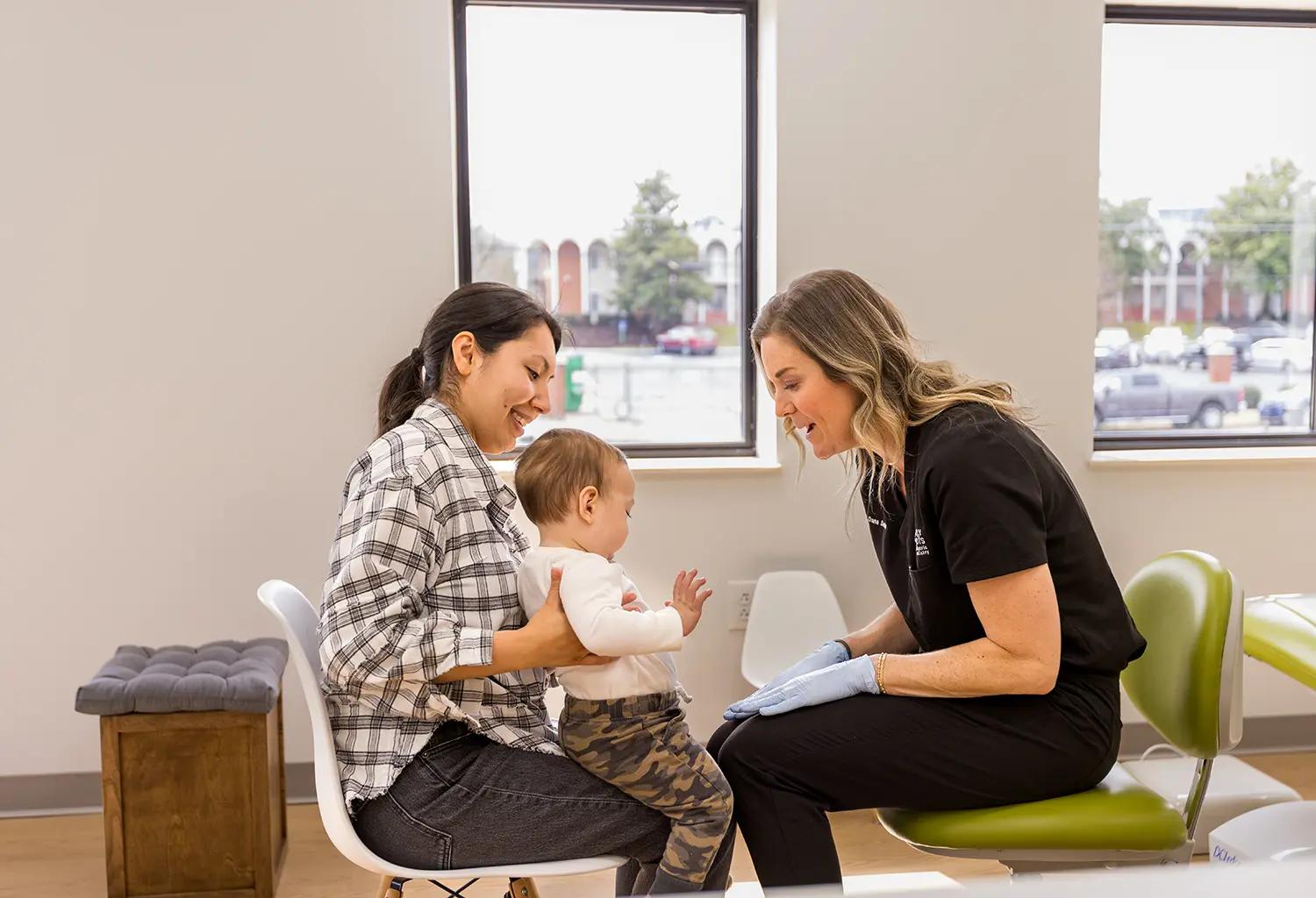
It’s short. Fifteen to twenty minutes, most of the time, and a good chunk of that is us talking with you.
Your baby almost certainly will not sit in the big chair alone. For infants and young toddlers we usually do what’s called a knee-to-knee exam: you sit facing one of our team members, knees touching, and your baby lies back across both of your laps with their head in our hands. Your baby can see your face the entire time. You’re holding their hands. There’s no separation, no reclining alone under a bright light, none of what parents are picturing when they walk in nervous.
In those few minutes we’re looking at:
- Every tooth that’s erupted, including the surfaces you can’t see from the front
- The gums, tongue, cheeks, and the roof of the mouth
- How the upper and lower jaws are coming together
- Whether teeth are arriving in a typical order and on a reasonable timeline
- Any early white or chalky spots on the enamel
Then we clean whatever teeth are there — which at this age takes about forty seconds — and usually apply fluoride varnish, painted on with a tiny brush and tasting faintly like bubblegum. It’s the same varnish we use at every checkup and cleaning as your child gets older.
The rest of the appointment is a conversation. Teething. Night feedings. Whether the pacifier is a problem yet. Whether that gap between the front teeth means anything. What to do about a kid who clamps their mouth shut at toothbrush time. Parents almost always arrive with more questions than they expected to ask, and this visit exists partly so you have somewhere to put them.
If your baby cries, nothing has gone wrong
Plenty of babies cry through the exam. A one-year-old being laid back by a stranger will often object, and objecting is a completely age-appropriate response — it isn’t fear of the dentist, because they have no idea what a dentist is yet.
It also doesn’t interfere with the exam. An open, complaining mouth is a mouth we can see into. We’ve never once thought less of a family because their baby was unhappy, and it’s not a sign of how your child will handle visits at three or five. The kids who sail through appointments at age six are, overwhelmingly, the ones who started coming in at one.
The things we’re looking for that you can’t see at home
Early childhood decay doesn’t look like the cavities adults picture. It usually starts as dull, chalky white lines right along the gumline of the upper front teeth — an area that’s hidden under the lip unless someone deliberately lifts it. By the time a spot is visibly brown or a child is complaining, the process has been running for a while.
Caught at the white-spot stage, that enamel can often be remineralized with fluoride and a few changes at home. No drill, no filling. That window is the single best argument for the one-year visit, and it’s a window that closes quietly.
We also flag things that have nothing to do with cavities: a tongue or lip attachment that’s making nursing painful, teeth erupting far outside the usual sequence, a bite developing in a way worth watching. We assess tongue and lip ties here and refer out to a provider who treats them when that’s the right step. Most findings are simply noted and monitored. Knowing early is the point.
Setting the appointment up to go well
A few things genuinely make a difference:
- Book around the nap, not around your calendar. A mid-morning slot after a good night’s sleep beats a convenient 4:00 p.m. every single time. If your baby melts down in the late afternoon, don’t schedule a first visit into the late afternoon.
- Feed them beforehand. Hungry plus new place is a rough combination.
- Fill out the health history before you arrive. Doing paperwork one-handed with a squirming toddler is nobody’s favorite part of the day.
- Bring the comfort object. The blanket, the giraffe, whatever it is. It comes into the exam.
- Watch your own tone. Babies read faces before they read words. Promising your child it “won’t hurt’’ introduces an idea that hadn’t occurred to them. Keep it flat and cheerful.
- Write your questions down. You will forget three of them the moment we start talking.
Home care, by stage
Before any teeth: wipe the gums with a clean damp washcloth once a day, usually after the last feeding. It’s less about hygiene at this point and more about your baby getting used to somebody putting a finger in their mouth — which pays off enormously in about four months.
First tooth through age three: brush twice a day with a soft infant brush and a smear of fluoride toothpaste about the size of a grain of rice. Not a pea, not a strip along the bristles like the toothpaste commercials. A rice grain. Children this age swallow most of what you put in there, and that amount is safe to swallow.
Once two teeth touch: start flossing between them. This is usually the back molars around age two to three, and it’s where a surprising share of toddler cavities begin, because a brush physically cannot reach that contact point.
Bottles and cups: the one habit worth guarding hardest is milk or juice at bedtime. Saliva flow drops off overnight, so anything sweet sitting against the teeth stays there for hours. Same principle applies to a sippy cup of juice carried around all afternoon — it’s not the sugar total, it’s how many hours the teeth are bathed in it. Water between meals, always.
A note on water in our part of Wake County
Families in North and Northeast Raleigh, Wake Forest, Rolesville, Knightdale, and Wendell are split between municipal water and private wells, and that matters more than most parents realize. Municipal supply in this area is fluoridated at a level meant to protect developing teeth. Well water is not — the fluoride content varies widely and can be near zero.
If your home is on a well, tell us. It changes what we recommend, and in some cases a fluoride supplement is worth discussing with your pediatrician. It’s a two-second question that we’d rather ask than assume.
Why baby teeth are worth all this
The fair question every parent eventually asks: they fall out anyway, so why does any of it matter?
Because they’re load-bearing. Baby molars hold the exact space the permanent molars need to come into, and when one is lost early to decay, the neighboring teeth drift into the gap. The adult tooth arrives to find its parking spot taken, which is one of the more common routes into crowding and orthodontic treatment later. Front teeth shape how children learn to form sounds. And a child with a toothache doesn’t eat well, sleep well, or concentrate well — dental pain is a leading cause of missed school days nationally, which is a strange fact until you’ve seen a five-year-old try to get through a Tuesday with an abscess.
The last baby molar usually doesn’t come out until somewhere around age eleven or twelve. These teeth are on duty for a decade.
Book a visit at Dino Kids Dental of Raleigh
We care for kids from that first tooth all the way through the teen years, and infant visits are real appointments here, not something squeezed into the schedule as an afterthought. Our office is on Tin Roof Way in North/Northeast Raleigh, off Louisburg Road just inside I-540 near Triangle Town Center — a short drive for families in North Raleigh, Northeast Raleigh, Wake Forest, Rolesville, Knightdale, and Wendell. If there’s a tooth, it’s time, even if it’s only one and the first birthday is still months away.
Dino Kids Dental of Raleigh
5321 Tin Roof Way, Suite 101
Raleigh, NC 27616

Phone: (919) 341-2257
Email: raleigh@dksmiles.com

Hours: Monday–Thursday, 8:00 AM to 3:00 PM. Select Fridays by availability.

Request an appointment online
Related pages
- First Visit & Infant Dental Care
- Kids’ Dental Exams & Cleanings
- Dental Sealants
- Habit Counseling
- Emergency Pediatric Dentistry
Frequently Asked Questions
When should my baby have their first dental visit?
When the first tooth appears, or by the first birthday — whichever comes first. That’s the American Academy of Pediatric Dentistry’s recommendation, and it’s earlier than most parents expect.
What happens at a baby’s first dental appointment?
It takes about fifteen to twenty minutes. Your baby lies back across your lap in a knee-to-knee exam while we check the teeth, gums, and jaw development, clean whatever teeth have erupted, and usually apply fluoride varnish. The rest is a conversation with you about feeding, teething, and home care.
Is a visit worth it if my baby only has one or two teeth?
Yes. Most of the value at this age is in catching early enamel changes before they become cavities, checking that development is on track, and getting you the home-care answers you need for the stage your child is in right now.
What if my baby cries the whole time?
That’s normal and expected at this age, and it doesn’t get in the way of the exam. A one-year-old objecting to being laid back by a stranger isn’t afraid of the dentist — they just don’t like being laid back by a stranger. It says nothing about how visits will go at age four.
How much toothpaste should I use on a baby?
A smear about the size of a grain of rice, twice a day, with fluoride. Move up to a pea-sized amount around age three, once your child can reliably spit.
When should I start flossing my child’s teeth?
As soon as any two teeth touch each other, usually when the back molars come in around age two to three. A toothbrush physically can’t reach the surface where two teeth meet, and that contact point is where many toddler cavities start.
Why do baby teeth matter if they fall out anyway?
Baby molars hold space for the permanent teeth coming in behind them, and losing one early to decay lets neighboring teeth drift into the gap. They also affect chewing, speech development, and jaw growth. The last baby tooth typically isn’t lost until around age eleven or twelve.
How often should my child come in after the first visit?
Every six months for most children. We may suggest a shorter interval if there’s active decay risk, a well-water household without fluoride, or a habit we want to keep an eye on.
Where is your office and which areas do you serve?
Dino Kids Dental of Raleigh is at 5321 Tin Roof Way, Suite 101, Raleigh, NC 27616 — in North/Northeast Raleigh off Louisburg Road, just inside I-540 near Triangle Town Center. Call (919) 341-2257. We see families from North Raleigh, Northeast Raleigh, Wake Forest, Rolesville, Knightdale, and Wendell.
